Friday, September 9, 2011

Elune, We Have A Problem

Sometimes when progressing through raid content, you encounter an unusual situation: you're failing. To be more specific, you're repeatedly falling victim to an avoidable damage mechanic. Hopefully, this situation doesn't arise often for you but when it does, it's vexing.

The other night, I found myself in this predicament. This is quite unusual for me. I'm not an infallible superstar by any means; I sometimes make mistakes with decision-making or will die to something I shouldn't have. However, I'm usually extremely good about not getting blown to bits by a straightforward, avoidable mechanic and I almost never make the same mistake repeatedly.

That being said, that is exactly what happened to me against Ragnaros. When he does his Sulfuras Smash (bringing down his hammer somewhere on the platform you engage him from) three waves of lava spawn from the impact point and rush away from the hammer: directly away from Ragnaros and in each direction perpendicular from the vector of the wave racing away from Ragnaros. (It's simpler in reality than to explain, basically it's right, left and forward).

This should be easy to avoid. Every guide says it is, it looks like it is to me and it's the type of thing I usually avoid with ease...without even thinking about it. Be that as it may, I was not avoiding it with ease. I wasn't getting hit by it every time (thankfully) but I was dying to it far more than I should have, which put a strain on my fellow healer and, thus, the raid.

So what do you do when this happens? It's frustrating, all the more so because it feels so out of character and you wonder if your raidmates are silently judging you. Maybe it's just a bad night, or perhaps it isn't. What's called for is a diagnostic process! We love processes here at Holy Word: Delicious. If all of life could be boiled down to a process, we here at Holy Word: Delicious would die happy (according to a proper death process).


Step One: What is the nature of the fail?


Obviously, you have to start with identifying what's going wrong. Nothing drives me to distraction more than someone responding to a "How did you die?" query with "I dunno."* If it wasn't apparent to you when you actually died, check logs and figure out what it was. Not knowing means it's going to happen again. And again. There are some useful tools to figure these things out, even during the raid. Make sure you always have some way to go back and check what happened, if it wasn't clearly apparent. You always have the in-game combat log, if it comes to that.

*You can get the craziest accounts from these types of people. "It was so weird, I was just standing there and then suddenly I was dead! Might be some kind of bug, because I was totally not standing in anything and didn't do anything wrong. What's that? There's a debuff the boss puts on you during that stage that makes you explode if you don't /point and then /dance? I didn't know that but I'm pretty sure that's not what happened. I don't think I had a debuff. I think it was a bug."

In my case, it was the above-mentioned Lava Waves that are produced from the Sulfuras Smash. Pretty cut and dry. I saw it hit me, I saw the DoT it placed on me and I saw my charred corpse immediately after. The arrow of causality isn't too hard to draw there.

The first step of the process, then, is knowing what the fail is.


Step Two: Why are you failing to that?


Would you like to be killed by this mechanic? (Y/N)
> nah
You do not fail.
> pew-pew
You critical strike the boss for ***48302*** damage!

This is not how World of Warcraft works ever since build 2938.12.21 in the original beta. Sadly. If we could simply choose not to fail, we never would. We are (generally) trying to never fail. So when we fail to something, there has to be a reason why. Why, despite presumably not wanting to fail, did we fail? (Believe me, even if you're not asking yourself that question, your raid leader likely will be eventually.)

So you have to have some sense of self-awareness. You have to be thinking about what's going on, or at least passively recording the events in your mind so that you can revisit them from memory after the fact and do a post-mortem. You need to know why that mechanic was a problem for you.

Here it was in my case: We were two healing Ragnaros (ten-man raid, obviously), which is quite do-able. I was primarily responsible for the tanks, but couldn't focus entirely on them. When two-healing the encounter, the raid can't afford one healer to be healing the tanks and no one else. There's too much damage to too many spread out people when things like magma traps are set off.

The tank damage was fairly spiky. The tanks swap due to the stacking Burning Wound debuff that Ragnaros applies to the tank he's currently pummeling (exacerbated by the Burning Blast ability that causes damage based on the Burning Wound stack). Ragnaros himself hits like a truck and the tank who isn't currently absorbing Ragnaros' abuse with his/her face is still taking enough damage from the aforementioned abilities (that take 20 seconds to drop off even when not tanking him) that that tank's health will still drop rapidly if ignored.

So. The tanks were leaking health rather rapidly and there were other raid members to heal. My best instant, Power Word: Shield, has limited value in the fight because someone who has just taken damage (other than the tanks) is not necessarily likely to take damage again within the duration of a Power Word: Shield (15 seconds). A shield that simply runs out of duration is nothing more than mana thrown into the fire (pun intended). So I don't have a ton of mobile healing. The feeling that someone would die kept me feeling anchored. This doesn't explain the failure (healers needing to move in addition to healing is nothing new), but the post-mortem isn't over.

The above issue naturally led me to trying to move the least distance possible to avoid the lava waves. Nothing wrong with that, that's what you should be trying to do. However, it led to a couple of issues.

  • If the hammer came down next to me, all I did was move to a diagonal vector from it, which is what you're supposed to do to be in the "safe zone" (since the waves move toward compass point directions relative to the hammer). However! If you're standing right next to the hammer, the waves are too close together for the diagonal to be safe...you'll still be clipped (annoyingly, the effect radius is larger than the visual radius, but that is nothing new in World of Warcraft).
  • If the hammer came down far, far away from me (like on the other side of the pretty enormous platform), I was making hasty guesses as to where the straight line vectors of the waves would take them by the time they reached my vicinity and moving quickly to where I figured the "cone of safety" would be. Sometimes I guessed right, sometimes I died.

These two situations were what were undoing me. This ties into the stationary feeling of having to heal without pause because, frankly, I was using flawed strategies to avoid waves in those two situations to minimize casting down time.

Now, let's be clear. This is an explanation for the purpose of personal diagnosis and improvement. It's not an excuse. I was not justified in dying to those waves, I wasn't the victim of unfairness. I'm laying it out, here, not to exonerate myself in your eyes (I mean, if I worried about your judgment, I wouldn't even have mentioned this, now would I? Right?) but to provide a concrete example of how, in my view, one should approach understanding the problem to solve it. You need to be able to explain it in your own mind. This really shouldn't be for public consumption (that is, for your raid) because it will sound like excuses. And you really shouldn't be intending to use it as an excuse. Explain it to yourself and understand it but do not confuse it with excusing yourself. You need to fix it.

So step two of the process is understanding why that identified mechanic is putting you in an early grave.


Step Three: So what are you going to do about it?


Breaking your keyboard is not the right answer.

Once you've identified the problem mechanic and discovered why it's a problem, the final step is to figure out the work-around. Every problem has a solution, unless you're pushing a world's-first on a boss that wasn't released on the PTR--then the problem may not have a solution until Blizzard hotfixes it while you're in the middle of your raid. But I digress.

You've broken down the ramifications of the mechanic and identified which aspect is making it difficult...so what action will neutralize it? Sometimes it can be as simple as an add-on giving you a BIGGER WARNING on your screen (complete with Christmas lights and a wacky waving inflatable arm flailing tube man). Sometimes it will require mapping out an actual movement or spell choice strategy ahead of time. In my specific case, it was the latter.

I had identified which situations were problems: hammer dropping next to me (not on me, I never got hit by the hammer itself!) or hammer dropping very far away from me. The hammer dropping at some midway distance was no problem...seeing the diagonal quickly and moving into it was easy.

The answers, once I knew the precise nature of the problem, turned out to be easy.

  • In the case of the hammer dropping right next to me, I had to move away from the hammer on the diagonal vector. Standing next to it, even on the diagonal, wasn't sufficient. If I saw that the hammer was going to be right next to me (and you do get an indication ahead of time), it was time to shield the tank, maybe put a Renew up, a Prayer of Mending and then get the heck out of Dodge. Get to the new spot and then spam fast heals to make up any deficit I had fallen behind on while moving.
  • In the case of the hammer dropping far away, I had to move forward into melee range, not backward looking for the diagonal. The hammer is always dropped far enough away from Ragnaros that a wave will never blast through his hit box. I can't stand in melee all the time to passively avoid waves because (designers being crafty like that) Ragnaros has a silencing knock-back...if you're standing in melee range and casting when he does it, you get locked out of the spell school you were casting in for something like 5 seconds (which is an eternity when the tanks are dying). But running into melee range and then back out immediately, after the wave has raced past, causes no ill effects.

Once I put these fixes into action, things got better immediately. It was immensely easier to avoid the waves and with minimum thought and movement (the better to use that thought and time for healing decision-making).

So the third step of the process is to create a plan that will work around the problems you've identified.


Step Four: I Forget What Four Was For


So, that's The Process. It's always nice to have a process to work through to solve problems. Admittedly, none of the steps I laid out are a revolution in logic, philosophy or spirituality, but it's good to formalize a thinking process rather than fall into the "Well, that sucked, I'll try to do better next time" trap. That's surprisingly easy to do and very tempting...you know the mechanic, you messed up, you'll just try harder next time. However, if there's a specific problem that's causing you to miss the mechanic, you'll probably keep failing at it until you (implicitly or explicitly) go through the above process.

Ultimately, if you still keep struggling with the mechanic, it's probably a bug. Or latency. Or a lag spike. "It was the craziest thing..."

Wednesday, September 7, 2011

How To Win Raiding

Those of us who enjoy the raiding aspect of the game are always seeking to raise our games, step up our efforts and engage in other sports/corporate cliches. In short, we want to be the best raiders possible. However, raiding guides usually deal in rather obvious tips like "Stay out of fire" and "Always have a food/flask buff." Those might help, but if you really want to become a truly pro raider, you need the advanced secrets of raiding.

That's what this piece is about. How to squeeze out the extra throughput that average raiders simply don't attain. Read on.


Select The Right Music


The right music in the background will make or break you as a raider. Average raiders listen to the default encounter music within World of Warcraft or to nothing at all. The finest raiders in world ranked guilds select the proper pop/rock/hip-hop/electronica/R&B/soul music to push them to higher levels.

So what is the proper music? That's a trickier question, as it doesn't follow simple rules. This isn't something basic like gear itemization; this is complicated. It has to be a playlist that energizes you at the right times but provides some chill cooldown when you need to recover your intensity. Ultimately, this is a difficult one to spreadsheet, though I'm working on it*.

*Preliminary research is revealing that balearic dance-pop is likely the "primary sound" that will be the baseline against which all other genres will be weighted, for all classes


When Forced To Move, Jump While Moving


You move faster when jumping. This has been empirically proven*. Further, jumping when casting an instant spell supercharges it slightly (though it's a non-stacking buff, so don't jump multiple times before casting it). I think Elitist Jerks had a thread on this at some point. In any case, I've never seen anyone specifically deny this. If you have to get out of poison, jump while moving to your new position.

*"Empirically proven" means "it feels true."

I shouldn't need to explain this...the faster you move, the sooner you can start DPSing or healing again. And stronger spells are always nice*.

*There is a reason restoration druids always top the healing meters.


Mentally Tack On A "Loot Phase" To Every Boss


Beth'tilac has three phases. The phase which she spends her time atop her web, the phase in which she descends to attack the raid directly and the phase in which you collect the loot she drops. Rhyolith also has three phases. Etcetera. When discussing boss strategy, it's important to know that this is the phase you need to reach*.

*This also makes explaining the fight to new recruits much easier--just get to phase 3 (or whichever phase is the loot phase for a particular boss)


Bonus Patch 4.3 Exclusive Tip: Dress For Success


This is really not a tip you can put into effect right now, but it's worth discussing since you'll soon be able to address this issue. Currently, Blizzard has introduced an RNG obstacle in raiding--the negative effect of ugly raid gear. Some tiers the gear is decent in appearance, some tiers the gear looks designed by a bored monkey. You have no control over this and Blizzard intends for this to be an RNG effect...it's filed under "demoralization effect" (distinct from disorientation, fear and stun effects).

However, patch 4.3 will introduce transmogrification...an ability meant for prepared raiders to remove this randomness from encounters, much as tanks push crushing blows off the table. You'll be able to modify the look of any visible piece of equipment you wear to any other similarly-slotted piece of equipment that you own, with a few restrictions. This means that it is incumbent upon you to create a fashion style that will remove the demoralization effect any time that your raid gear looks terrible. If you don't do this, you cannot honestly claim to be giving your raid your best effort.

Wednesday, August 31, 2011

Discipline Priest Chakra

If you're plugged into the priest scene, you're probably aware of a talent-based mechanic in the priest holy tree known as Chakra. The purpose of Chakra is to allow the holy priest to "switch modes" between single-target and area of effect (AoE) healing, getting upgraded tools for each role when in the appropriate "stance."

The Chakra family of talents is not available to discipline priests, as it resides too deeply down the holy tree and requires an important spell that you only receive if you select holy as your specialization.

However, the way that discipline priest healing has shaken out this expansion, discipline priests work in very much the same way...they just don't activate Chakra before switching modes.


Single-Target Healing


This is either "traditional discipline" or else "new wave discipline" depending on whether you like the Evangelism/Archangel/Atonement mechanics and, if so, how you use them. I'll have a future article discussing "new wave discipline" and clarifying the best way to look at it, in my experience. For now, though, let's quickly summarize each.

Traditional discipline works this way when you're healing someone (usually a tank) through continued and reasonably intense damage: you put a shield up. You get a Prayer of Mending on the target. You begin casting Heal (if the shield hasn't been broken and the damage isn't expected to be massively spiky) or Greater Heal otherwise. The reason you immediately start casting those spells is because they will reduce the duration of the Weakened Soul debuff, allowing you to get a new shield up as soon as possible and have a further benefit of stacking up some Divine Aegis shielding when and if you critically heal. As soon as the shield has broken and the tank is actually taking some damage, use Penance on cooldown, refreshing Power Word: Shield and using Prayer of Mending whenever they're available. The rest of the time, you use Greater Heal and reserve Flash Heal for emergencies when the target's health is dropping toward death quickly. If you and the target are both hurt, Binding Heal is reasonably efficient.

If the target (like a DPS or fellow healer) is not taking big, consistent damage, you simply spot heal with Penance or Greater Heal (using Binding Heal if you are also damaged).

Healing is a dynamic, situational endeavor that doesn't lend itself to spell rotations, but that's the general work flow. You'll adapt it based on how the fight is going.

The Atonement style ("new wave!") is actually not hugely different in execution, but does have the added novelty of weaving in some Holy Fire and Smite. This mechanic also gives you an extra button to press in Archangel, a healing buff on a 30 second cooldown.

So that's single-target healing in a nutshell. Let's see how area of effect healing is done in discipline and how it differs in spell usage.


Area of Effect Healing


Using the term "area of effect" is a bit of a misnomer, because the way discipline priests heal a number of people really isn't based on a specific area (outside of the range of their spells, of course), but so many mass heal spells are area-based, so it makes a good catch-all term. This is generally for periods when raiders stack up for a big "burn" phase which are extremely common in Firelands (Beth'tilac phase 2, Lord Rhyolith phase 2, Alysrazor phase 4, Majordomo Staghelm scorpion phases, Ragnaros phase 2).

Here's how you do it with discipline: Select a group in your raid and cast Prayer of Healing on that group. Select a different group and cast Prayer of Healing on it. Select a third group (if you're a ten man raider, this will be the original group) and cast Prayer of Healing on it. Etcetera.

(The reason you want to alternate/switch groups each time is not just to balance out healing but also to avoid clipping the heal-over-time [HoT] that this helpful glyph provides when you cast Prayer of Healing.)

To be sure, there are some nuances you can take advantage of...for example, casting a Power Word: Shield on someone (like a tank) between Prayers of Healing in order to haste each Prayer with Borrowed Time. If you and someone else are going down in health faster than others for some reason, you can resort to Binding Heal. Once and only once per fight you can toss out a Divine Hymn, which will also boost your fellow healers' efforts. You also want to keep Prayer of Mending out on cooldown.

By and large, though, you ride Prayer of Healing to victory. That's discipline AoE healing: spam Prayer of Healing. There is no toolbox, just one (pretty powerful) tool.


Switching Modes


Discipline priests, then, have two pretty discrete "modes" that they switch between. In one they use a pretty diverse toolbox (there are more spells that can be used situationally that I didn't mention, like Renew) whereas in the other, the toolbox nearly collapses down to one spell, like a star collapsing into a neutron star before exploding in supernova.

Sometimes those modes line up nicely with phases, but sometimes they don't. Therefore, keeping a bit of the holy Chakra mindset is good even in discipline; the way in which you heal and the spells you use change and the difference is very stark. You just won't be pressing Chakra when you want to switch modes, but the mindset should be the same.

At any given moment, be ready to let your toolbox collapse into super-dense Prayer of Healing spam and let loose an AoE healing supernova.

Saturday, August 20, 2011

Transmogrify All The Things!

The World of Warcraft community has been agog over the new functionality Blizzard unveiled for patch 4.3, known as "transmogrifying" (and by "agog," I mean many people are excited, many people hate it and some people don't care. You know...agog!).


Via the magic of transmogrification, you can make one thing look like another:

 Pictured: Science!


If you haven't read all the details on this magical scientific progress, please do click the link I provided above and read all about it. It's fiendishly interesting if you enjoy designing things, customization, style or dress-up. The basics are that, with a few restrictions, you can make one thing you own look like another thing you own, provided they are the same armor/weapon type and the same equipped slot.

This, of course, got me to thinking. I like designing things*. I like customization*. I like style*. I like dress up (apparently...I farmed a lot of fancy gear that is outdated and not useful for end-game). How would I use this new system on my main character, a female blood elf priest?

*None of these likes of mine may be evident in design of this site. That speaks to another liking of mine: laziness.

Well, that got me thinking further: what would be the ideal priest outfit? An outfit to fight and heal in, one that evokes priestliness and shows off fine, sophisticated style. It should be elegant, regal but not garish.

So here are the essential pieces that I've decided on for the Definitive Priest Look (all images courtesy of wowhead). Your DPL may vary, but I think this is a fun exercise that you should perform with your own main (of any class, of course). After all, how your character looks is one of the most important forms of self-expression in the game. Present your personality! 

Incidentally, I'm probably way too excited about this feature. To me, patch 4.3 is Transmogrification and oh yeah, the Deathwing raid plus new heroic dungeons and a total revamp of the threat system. Ah, c'est la vie. 


Head


This one is tricky. Remember I mentioned that there were "some limitations" on the gear you could use to source the look for a transmogrification? Well, one of those limitations, at least for now, is that the source material must have stats. That's a little ambiguous. If it means stats in the form of "+X" to a primary or secondary statistic, that essentially limits this to uncommon (green) quality items and better. 

However, some common (white) items have armor. Armor is certainly a stat, a rather important one to tanks. And there are equippable items with no armor, generally holiday gear. So it might be that white items with armor can be used and white items without armor cannot be.

If white items with armor qualify, then the Crown of the Fire Festival is pretty brilliant. It's a soft, subtle halo. Might seem a bit "on the nose," but I think it really does add a certain aura! 


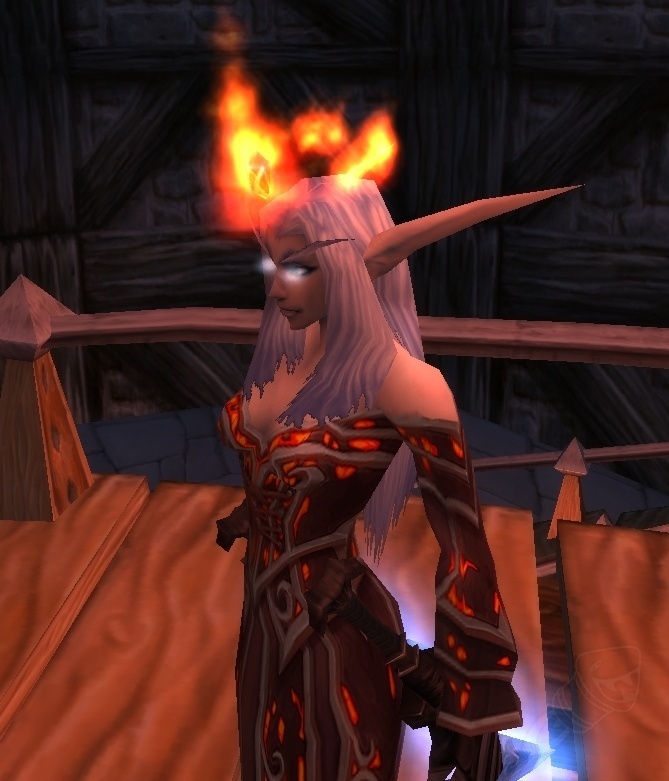
Now, if such white items won't qualify, we have a couple of alternatives. I'm sticking with the halo/tiara of light concept. We have the T7 head, from the token that Kel'Thuzad in Naxxramas drops.


Finally, we have the Circle of Flame from Ambassador Flamelash, in Blackrock Depths.


In terms of the relative merits of the two back-up options, the tier 7 piece has the softer look that I think makes a better accent to an "always on" outfit. The Circle is more spectacular and the colors of the flame will go better with the rest of the outfit, but the "tower" of flame in the front can somewhat obscure your lovely face. The Circle is easier to get, solo.


Shoulders


A little gold is going to go a long way here. Red and gold is ideal but other accent colors to the gold will also work. That said, then, the perfect shoulders as far as I'm concerned also come from tier 7: the Heroes' Shoulderpads of Faith. The red and gold motif will nicely complement the golden halo or the orange-red fire tiara mentioned above. In addition, there's a pretty "shadow of light" emanation from the back.


If you can't use the Crown of the Fire Festival and don't have the Circle of Flame, or you don't want to farm Naxxramas for the tier token to get the Heroes' Shoulderpads of Faith, fear not. There's a good option that just costs a few justice points: the Valorous Mantle of Faith. It's also a tier 7 token set of shoulders, but this token you can buy with regular old justice points that you have kicking around. No need to farm Kel'Thuzad. These look the same as the above shoulderpads, except the accent color is blue-green instead of red. 

Addendum: The tier 1 priest shoulders, the Mantle of Prophecy, is both spectacular and a perfect fit in this set. It drops off the Sulfurion Harbinger, a boss in the Molten Core. I just love the regal look of the vestments hanging from either side of the neck.


Chest 


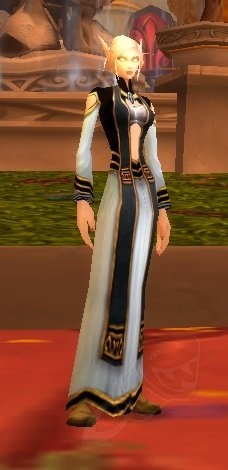
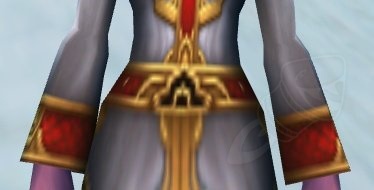
To me, there's a clear winner here, and it's actually not a particularly hallowed robe in terms of stats, level or notoriety. It's the Runecloth Robe. The white robe with the embroidered vestments down each side. It's both priestly and very stylish, in my opinion.


This used to be a limited supply pattern from a vendor in Moonglade, but now it's a baseline pattern that you can learn from any tailoring trainer. If you are not a tailor, essentially any tailor can make it for you. No need for alternatives here! 


Wrists


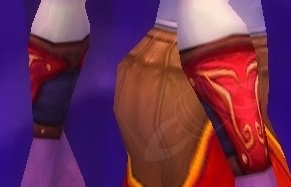
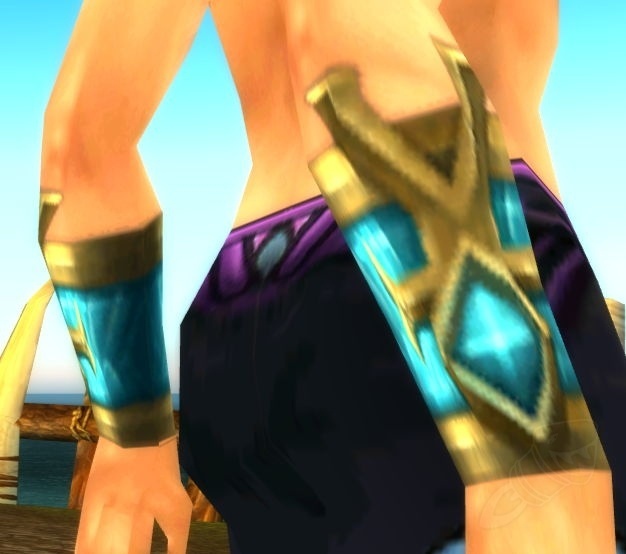
If you have the first option shoulderpads that I mentioned above, the wrists that go best with them are hugely easy to get. The First Sergeant's Silk Cuffs are vanilla PvP bracers and cost only 55 honor points from a legacy PvP quartermaster in Orgrimmar. 

Unfortunately, the Alliance version of these bracers (the Sergeant Major's Silk Cuffs) look completely different. Therefore, I would recommend the Flameheart Bracers if you are/can become friendly with the Aldor in Shattrath or the Bracers of Havok if not. Both of them look the same.


They are arguably better looking than the First Sergeant's Silk Cuffs...on one side, the red and gold side. However, the purple patch is a bit distracting as it doesn't fit much else in this ensemble. That drops it to "sub-optimal alternative" in my view. But still rather good.

Finally, if you weren't able to get ahold of the 10 man version of the tier 7 shoulderpads, the red and gold ones, but instead got the blue and gold 25 man version, then I have a pair of bracers to match the shoulders. Behold, the Runed Spell-Cuffs. They have an identical blue-green and gold motif and should complement the shoulders nicely.


You can purchase these from a vendor named G'eras in Shattrath City for the low, low price of 182 justice points.


Cloak


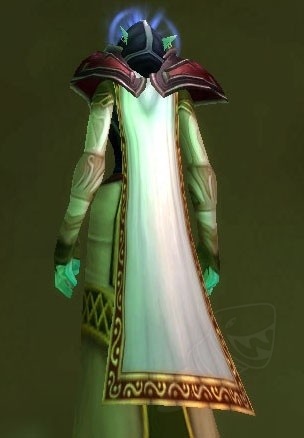
We'll need to visit G'eras anyway, because the first option for cloaks comes from him. He has the Cloak of Swift Reprieve. This a snowy white cloak with a red and gold trim. Considering the color themes of this outfit, this cloak is a natural fit.


Another 312 justice points from our fine Shattrath vendor, but style is important!


Feet


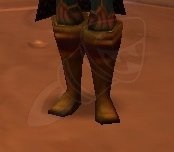
Back to the Midsummer Fire Festival. If those items are allowed (again, it has armor), then the Sandals of Summer round this set out nicely. They're just golden shoes, and the feet (as opposed to the ankles) are all that can be seen with a robe.

However, if they're not allowed, then we can go with the Omnicast Boots instead. They drop from Golem Lord Argelmach in Blackrock Depths. Ah, BRD...thank you for your contributions to style. These are simply golden hued boots, which work just as well peeking out from under your robe.


Hands


So, I suddenly realized that gloves are important to cover, as they can still be seen with the other gear. Then I realized that the gloves I'm going to use with this ensemble cover up the bracers. All of this I discovered after writing up the bracers section. Which makes that section a complete waste, but I'm leaving the bracers section in because deleting it all just feels wrong.

So, which gloves are these, the ones that make the bracers irrelevant? The Red Mageweave Gloves. They're red with gold filigree. They fit in nicely with the largely red, gold and white theme we have going here. They look really wonderful, as far as I'm concerned.


The only downside is that the pattern for these is a random world drop. So unless you feel like farming random mobs for a while, your best bet is to find either the gloves or the pattern on the auction house.


Waist


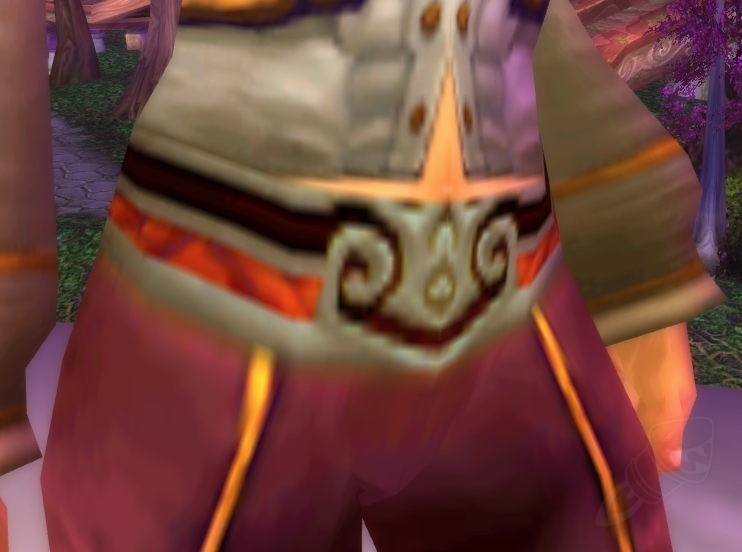
That just leaves the belt, in terms of armor. I've been looking through a lot of belts and there really isn't a stand-out that I've found. The belt that I decided on wasn't amazing, but it was nice enough and I included it because it at least ensures that an un-transmogged belt won't clash with the rest of the outfit.

I settled on the Mage-Fury Girdle. It has a red-and-almost-gold look that fits in decently with the rest of the ensemble. The metallic accent is really more of a brass look, but the belt has nice art and the red is strong enough to allow it to fit in, as far as I'm concerned.


Addendum: So, similarly to the shoulders, I realized after publishing this that there is a really nice belt option. The Girdle of Prophecy. Can you tell I just "discovered" the priest tier 1 set? I've seen it before, but the head (which I hate) soured me on it and I didn't pay close enough attention to the other pieces on an individual basis. However, like the shoulders, the belt is really lovely.


This is now the top option for this ensemble, as far as I'm concerned. Better yet, I happen to have it in my bank, so no need to farm the other belt anymore.


Weapon (Which Is To Say, Staff)


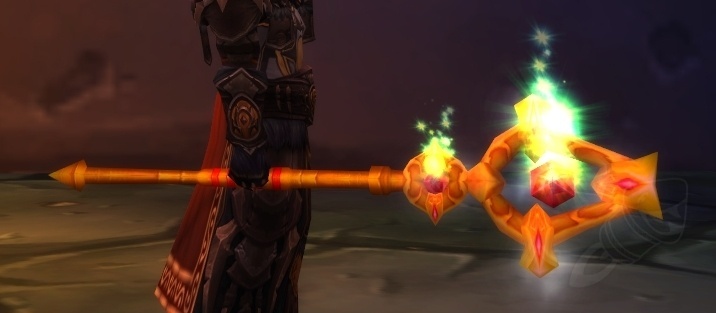
We have some options, when it comes to a weapon. We could use a staff, or else a dagger and off-hand or a mace and off-hand. However, I'm focused on staff-wielders, because of one weapon: Benediction.


Benediction is arguably the single most iconic class weapon in the game (though, of course, there are choices one could argue for, like Rhok'delar, Longbow of the Ancient Keepers). Not only is it hugely recognizable as symbolic of the priesthood in Azeroth, it's also a beautiful model with a spectacular "enchantment effect" (which is always present...it's part of the skin and overrides any enchantment placed upon it).

With the ability to transmogrify, and therefore the ability to effectively wield Benediction at any level, I may never wield anything but a staff for the rest of my priest's career!


Pulling It All Together


I didn't mention leggings to use because the leggings can't be seen with the robe. Therefore, there's no need to spend money on transmogrifying whichever leggings you use...your image will be unaffected.

If you would like to model the entire outfit, you can do so at wowhead here. Click on the small arrow in the upper left of the box containing the icons of all the items. Select "View in 3D" and then use the drop-down menus in the pop-up viewer to select the race and sex of the model you want to use. My priest, as I mentioned, is a female blood elf, so I aimed the outfit to suit her best (in my taste).

For those not inclined to go to those lengths, I'll post two images of the completed outfit from the viewer (as I still need to go farm the belt in the game!), front and back, to see the cloak and the shoulder special effect.


Of course, ultimately, the idea of this post was not really to imply that you use the same pieces of clothing for your priest's transmogrifying, even if you have a priest. It was to express my own exuberance at this new feature and urge you to do something similar, in terms of process: put together, in your mind, an ideal "look" for your main and then start finding the pieces you need to make it happen. That process is an enjoyable way to kill time and then you also have the mission to go out and acquire those pieces.

Also, remember...you're not restricted to just tier sets. If your favorite look in the game was a full tier set, great! But also consider mixing and matching a bit to build exactly the look that suits you.

If you're experiencing the summer doldrums, either because you're not raiding or between raid nights, this provides a whole new objective. Prepare yourself to outfit your main character exactly as you've always thought he or she should look! The choices you make for your main character's look is a major form of self-expression and you should take advantage of it.

Friday, August 12, 2011

Priest Shield Slam

Protection warriors have long been familiar with shield slamming. It's a key weapon in their arsenal when bugbears are trying to chew their faces off from the inside. However, it's also a key weapon in the arsenals of discipline priests who are healing tanks that have bugbears trying to chew the tank's face off from the inside.

One small difference: protection warriors target enemies with their shield slam, while discipline priests target tanks (possibly DPS, but DPS is really only there to shorten the fight so you can go watch TV).

It's really not a new technique (in fact, it might be a stretch to call it a technique) but I'm likely the first person to give it a name. And I'm without doubt the first person to apply for copyright on that name...the law offices I contacted about it confirmed that (or so I interpreted their "You want to do what? Who would be silly enough to do something like that?").


Shield Slam


Priests have a somewhat obscure ability known as Power Word: Shield. Discipline priests tend to use it quite a bit, though. In the latter stages of the previous expansion, they often tried to put it on as many targets as possible. It was the measure of first resort. Escalating mana costs (relative to mana pool) and a lowering of its duration effectively killed that strategy, but it's still something most discipline priests endeavor to cast on their target of main focus (like a tank) as often as they can (while, talented, it doesn't have a cooldown, it has an effective cooldown on a particular target due to Weakened Soul).

However, there are times when it's a better idea not to use it whenever you can on your main target. This has costs:
  • Power Word: Shield is a pretty strong throughput spell (30-40k effective HPS on a target taking continuous damage with an instant cast, and up to 60k with the glyph)
  • The Weakened Soul debuff it applies boosts healing from the priest due to talent
  • A further talent, Rapture, provides major mana returns when the shield is broken (subject to an internal cooldown on the talent)
(The last can be mitigated by using a Power Word: Shield on another target instead, if there's another target taking continuous damage. An unpopped shield provides no mana returns.)

So when and why should you bypass these benefits? When you can expect a moment in time when any other spells (even Flash Heal) might be too slow or even impossible to cast and you can't count on other healers, you need to have Power Word: Shield in your back pocket, to slam the door on damage for a short time until you can restore stability.

Before I provide some examples, let me point out what I am definitely not saying: You should not normally treat Power Word: Shield as an emergency cooldown. Most of the time, you want to be using it as much as you can if you're tank healing. The improved throughput and mana efficiency (due to Rapture) usually make it an important ability to use as much as possible on your primary focus. Usually.


But This Is Not "Usually"


The first example I'll offer is being one of the two healers in the Alysrazor fight. I won't go through the entire encounter, as many, many...many guides exist for that. I'll briefly explain, though, the task of tank healing in phase one such that the reason to "shield slam" becomes evident.

In phase one, each of the two tanks is holding a Voracious Hatchling. Healing through the hatchling's normal melee is largely uneventful. However, they have two mechanics that can quickly make matters tricky. The first mechanic is Tantrum. The second mechanic is Gushing Wound. These two mechanics occur independently, which means they can (and often do) overlap. Or they can follow one another with no gap between them.

So you often have a case where you're letting your tank's health drop under 50% and then dealing with an enrage, essentially. The hatchlings hit rather hard and rather fast at that point, so if the tank's health is under 50%, there is the risk of losing the tank.

This is a good time to shield slam. Let the tank's health drop below 50%, causing the debuff to drop off, and then instantly drop a shield on the tank, shutting off the Tantrum damage for a precious few seconds. Your tank's buffer is not really his/her health. It's the time left before the tank dies. The sub-50% health is part of it and time provided by stopping the damage is the other part, which is why mitigation and absorption are so valuable. You're essentially increasing his/her effective health, which is crucial in a dicey situation like that.

Shutting off the damage gives you time to catch up, after artificially being forced to fall behind. There are other ways you could handle this (for example, not letting the tank drop below 50% and healing through both Gushing Wound and Tantrum until Tantrum ends) but that's less mana efficient and waiting for Gushing Wound to drop allows you to quickly throw a heal on someone else if necessary. And if the Tantrum follows directly after a Gushing Wound, even that is not an option.

Moving on to another example, let's examine how my guild does Baleroc. What I've heard is that the Shards of Torment are supposed to spawn in melee, but that's not what we were seeing. They appeared to spawn on random players, whether they were in melee or at range. Ultimately, we dealt with that by having two stack-up spots...we all--tanks excepted--started on one on those spots, when a new shard of torment had been announced and was soon to spawn, we all moved en masse to the other stack-up spot except the next DPS in rotation to soak the shard. Each subsequent shard, we repeated the maneuver, moving back and forth between stack-up spots.

We may have missed something crucial, but this is the behavior we were seeing for shard spawns, so we adapted that strategy to deal with it and it's worked for us. It did, however, have one important consequence: healer movement.

On every shard spawn, every healer was in motion. This was a problem when the tank taking the Decimation Blade strikes had just been...struck. Suddenly the tank is around 10% health and has to be pushed back up to about 100% health before the next strike arrives, and all the healers are moving.

This is an ideal time to use what I've dubbed "shield slam." You may have noticed that the tooltip for Decimation Blade said that it ignores mitigation effects. Mitigation refers to effects like "take 10% less damage." It doesn't apply to good old absorption, and Power Word: Shields will absorb Decimation Blade damage. With a large Vital Flame buff, those shields can absorb a great deal of the Decimation Blade. Therefore, dropping it on the tank just before you move, ahead of the strike, means that you (and your fellow healers) arrive at the destination with significantly less damage to heal up (which is good, since the movement also means you have less time).


Slamming The Door (On This Article)


I've gone through a couple of examples of when you want to limit using Power Word: Shield so that you can use it at crucial moments. The specific examples may not apply to you, depending on how you do those fights or whether you're doing those fights at all, but the concept is still worthwhile.

Often times, maximizing the uptime of powerful abilities is most valuable. They have cooldowns (of one type or another) for a reason: the more often you can use them, the more powerful you are and therefore Blizzard doesn't want you using them too often. However, maximizing uptime is not always ideal. Sometimes, you want to maximize the leverage of something...that is, maximize the value by using them at the specific times when they'll count the most.

To use a baseball analogy (skip down to the next paragraph if baseball, analogies or baseball analogies bore you), it's the difference between maximizing a pitcher by getting the greatest number of innings out of him or by maximizing the leverage of the innings he does pitch. Starting pitchers are an example of the first...they throw as many quality innings as they're capable of and maximize their value that way. Relief aces are an example of the second; they throw many fewer innings but they come into the situations that you know have a major bearing on who will win the game (close game, near the end) which reduces the frequency of "wasted good innings" like a shutout third inning of a 13-2 game.

Most of the time, you want to maximize uptime of Power Word: Shield. But be alert for those times when you'd rather maximize the leverage of it. Shield slam to victory, the priest way.

Monday, August 8, 2011

Raid Leading For The 21st Century

Raid leading is an activity that can be both overrated in importance and underrated. Like coaching in professional sports, ultimately the "talent" being managed has the biggest impact on success. No matter how good a leader you are, you need smart, dedicated players. If you have that, though, smart and efficient leadership can either maximize the efforts of those players or leave a little potential on the table.

I do not currently lead a raid, but I have in the past. My thoughts on how a raid should be led are partially based in what I've done and partially based on what I've seen others do while in the raids they led. As my focus on this blog seems to have evolved into thinking about processes in playing World of Warcraft, I thought I'd try to formalize my thoughts on the process of leading a raid team.

I should also note that these principles are meant to apply to guilds that are progression-minded. Guilds who have a more casual, social mission are just as valid and worthwhile, but will probably want to proceed in a different manner.

Follow me, then, on this intellectual raid. I cannot promise you'll get the drops you hoped for, but hopefully the fight itself will be reward enough. </tortured-analogy>


Populate Raids For Fairness Not Inclusiveness


Rotating raid members so that more than the maximum your raid format allows (10 or 25) can play is great...if all the raid members in question are of relatively similar ability. That doesn't mean small variations in ability should deny certain members from ever getting a raid spot, but you don't do anyone any favors bringing people who can't quite pull their own weight, unless it's for farm night. Not only does your raid team start struggling to down the bosses they would have normally, it's not going to fun for the person shoehorned in to feel the pressure of being the reason for the struggles.

Like any other competitive endeavor where spots are limited, you'll create the healthiest environment where implicit competition (that is, the best performers--counting in awareness--go to raids) rules. This does not mean that it should be a hyper-competitive atmosphere, with elitism and trash talk being tolerated. Being dedicated and competitive in no way requires fostering a society of assholes, to put it directly. Assuage your guilt, if you feel it, for not inviting certain people to the progression raid by working with them (if they're receptive) to close the gap. Make sure you get them into farm/alt raids. Your goal should be to legitimately have more qualified raiders eligible for the rotation, not artificially forcing unprepared raiders into the rotation.


Keep Fight Explanations Concise


I'm going to be honest--anyone who deserves a raid spot should already know the general mechanics of any fight that it's plausible that your raid might encounter that night. That means, at a minimum, the encounter your raid team is currently working on and the encounter you plan to get to next. No one should be joining the raid and winding up at the boss pre-pull needing to know how this fight works. If you want to stress a certain point or two about the fight for people to especially focus on, or a quick note on how you might plan to deviate from the popularly accepted way to attack the encounter, that's fine. Explaining the entire fight, every phase and mechanic, costs the raid team time and focus. Many people zone out during long explanations, right when they should be entering a state of sharp focus.

There is one major caveat to this: If you're bringing in a new raider to your rotation, who has yet to enter the raid instance you're doing, it may be that you have five or six bosses on farm and it's the seventh that you're working on. It can be overwhelming to demand that the new raider learn up to eight encounters for the first night (though, it's far from impossible...I've done it!). If this is the case, limit the fight explanations, before each encounter, to just the things that single person needs to know. A new DPS doesn't need to know about the tank swap on Cho'gall. A new DPS doesn't need to know about what to do while flying, against Alysrazor, if they're going to be on add duty. If they would like to know the entire picture of the fight, ask them to consult their local library. For now, they just need to know what they, personally, must do to help the raid defeat the boss.

Again, blasting through each of the twenty mechanics in play on an encounter isn't going to do anyone any good. Not even the person who's benefit it is for...there is little that is more disorienting than getting a rapid fire recitation of three phases, each with six items that occur, that you need to memorize and utilize with no time to process and consolidate the information. Even the new person will be far better off with an explanation laser focused to just the mechanics that they, specifically, will deal with.  Wasting precious raid time and benefiting no one is clearly a mistake when leading a raid.


Transparent Loot Council


This is probably going to be the most controversial element of my post, but let's be frank: people, like raid leaders, already have a large element of control over what loot an individual member gets. By selecting who comes to a raid or encounter, they've determined who even has a chance at loot. Crafting materials, often very valuable, are also often not distributed by DKP, EPGP or /roll. Many guilds take the crafting materials for the good of the guild and distribute it later based on their view of need.

So, it's not like the concept of people in the raid or guild making decisions on loot is repugnant to most people. What I think generally is repugnant is a loot council that operates like a secretive cabal. That's when suspicions of favoritism or poor decisions happen.

(I recognize that in many guilds, loot distribution policy is determined by the guild master and/or officers, not the raid leader specifically. In those cases, consider this section to be more "guild management as it relates to raids" rather then specifically "raid leading.")

Let's first go into why a loot council is valuable, assuming this loot council is run correctly (which I'll get into later). Loot serves two purposes: fun as individual fulfillment of getting a new piece of gear and a tool to strengthen the raid to aid in the fun of downing difficult raid encounters. The more progression-oriented a guild is, the more they should want to focus on the second, viewing loot less as individual reward and more as tools to be efficiently deployed in maximizing the raid's overall power.

That is certainly not to say that the fun of personal progression (your individual power increasing) should be completely forgotten--but it should be secondary. That means that a clean rotation of loot is not necessarily ideal; if a piece of loot can best be used by someone who happened to get the last piece of loot, you're weakening the efficiency of the raid if you deem that person ineligible for this piece of loot. There is personal fairness (everyone rotates getting loot) and group fairness (improving the team's chances of winning). The members of a progression-oriented guild should have little problem with prioritizing team fairness over personal fairness--assuming they can be assured that "team fairness" is being served.

That's where we get into transparency. While the initial chatter of the loot council, the back-and-forth discussion if any, doesn't necessarily need to be broadcast to everyone, the reason(s) for the ultimate decision certainly need to be. "TraderJoe is going to get the bow," is not an acceptable statement to the raid. "While both TraderJoe (a hunter) and VicRush (a warrior) can use this bow and the stats can benefit both, the agility will benefit TraderJoe much more and ranged weapon DPS is a huge factor for hunters while it has no effect for warriors. Therefore, TraderJoe will get the bow" is an acceptable statement to the raid. It forces behind-the-scenes favoritism out of the equation--at least, overt favoritism. Favoritism could still rear its ugly head via weak rationales aimed at moving loot to a specific person.

That is why these loot council positions should be elected spots, voted on each month. Presumably, the raid will initially elect the three (or however many people you decide to place on the council) most trust-worthy and knowledgeable individuals in their eyes. If it turns out that any of them were actually ill-suited to the position, that can be set aright. You can vote each week, two weeks, a month...the period is really up to what works for your guild. But they should be accountable for their decisions, so they have incentive to make good decisions.

The fact of the matter is that just rotating loot doesn't always yield the optimal distribution. A lot of guilds will invoke the "common sense" clause in their charter regarding loot distribution, but one person's common sense may not be another's. Involving several people, people that the raid/guild members respect, and keeping those people responsible for making wise decisions and communicating those decisions reduces the risk of bad outcomes and the ensuing guild drama.

There's a saying that the best (conceptual) form of government is a "benevolent dictator." The reason for this is because a dictator can rule most efficiently (lacking the bureaucracy to slow their efforts) but, being benevolent, uses that power for good, not evil (greed, ambition, etc). I'd modify that to say that best form of loot distribution is enlightened loot council. A loot council that is picked for knowledge of how classes work and trustworthiness, can be modified if they overstep their bounds and distributes loot to those best able to use it.


Did You Ever Have To Make Up Your Mind?


Decisions. You must make them. Further, you must make them quickly and decisively. It's perfectly reasonable to solicit some input...the bigger the decision, the more input is reasonable. However, when it is during a raid--like deciding which boss to attack next when you have choices--time is of the essence.

As an example, imagine a raid rolled into Firelands on their first raid night doing heroic content. Perhaps their choice was to go after Beth'tilac first and Shannox second. They thought it would take the entire night, at least, to get both down. To their shock and delight, they one-shot both bosses, never having done the encounters before on heroic mode. Great...but now what? They have half (thanks to trash) or more of the raid night remaining. Perhaps the guild knows both the Alysrazor and Lord Rhyolith fight on heroic (from reading up on it). Which boss to go to next? The raid leader, talking it over with officers and perhaps others, takes fifteen minutes to make this determination. In a three or four hour raid night, fifteen minutes is a pretty significant chunk of time. Raiders also lose some focus as they wait around for a decision.

That should not be you. You'll have to make decisions quite a bit...whether it's choosing the next boss, shuffling the raid make-up on a per-fight basis, calling for a wipe in a pull gone poorly or perhaps even deciding when to call a raid night to an end for one reason or another. Taking undue time in making these decisions will not destroy the raid, but it will weaken it a bit, dropping its potential slightly.


The Great Communicator


As a raid leader, you must be a good/great communicator. Your job is not merely to make decisions--it is also to communicate those decisions to anyone affected. Your decisions will negatively affect some people, obviously, and it falls to you to ensure that they are given a reasonable explanation for why they got the short end of the stick. A "reasonable explanation" means an explanation that a mature adult can understand the logic and fairness of, delivered without rancor.

You may at times have to play counselor. Any leadership position involves managing people, which means understanding their concerns and displeasure and helping them get past those without adversely affecting the raid itself. If you don't have patience or the willingness to discuss issues outside of raid times, you can't effectively raid lead. We'd love for everyone in a raid to be an efficient machine that leaves emotion out of the equation--but that doesn't even happen for sports teams consisting of highly-paid athletes. Given that, you certainly can't expect it from a group of people playing a game and playing for your raid for free (by which I mean, the guild or raid doesn't pay them...not that World of Warcraft is free). People will get angry or unhappy or frustrated from time to time, and it is definitely your job to handle it gracefully. If you feel that it's unfair to have to play therapist in a game, then you should pass the raid leadership to someone else.

Finally, you need to foster a sense of camaraderie and good spirit within your raid group. People can play together with no sense of connection, but people in all walks of life tend to perform a little bit better when they're a part of a social interaction that they enjoy. It also makes your raid members more willing to deemphasize personal progression for the good of raid progression and less prone to drama flare-ups.


Leadership Is Just Facilitation


Really, the core idea behind all of these principles is being the person that makes raiding smoother. No more, no less. You're not there to "raise everyone's game" or to be a scolding parent or to keep everyone on the straight and narrow. You're just there to ease everyone else's raiding experience, allowing them to focus purely on their efforts within each combat. If you're doing your job well, people will only notice smooth, enjoyable raids...not you.

Thursday, August 4, 2011

Ragnaros Wants You To Try Harder

I haven't posted in a while. Did you miss me? No? Well, straight to the text then.

Recently, I feel that I've fallen into a common pitfall...common in World of Warcraft and common in the Real World. Reaching a point of comfortably adequate performance and settling into cruise control. I think I'm a competent healer. Better than competent; a good healer. It's notoriously difficult to rate healing proficiency and notoriously difficult to self-evaluate (what with competing dynamics of seeing yourself in a sympathetic light--after all, you know what you meant--and wanting to be tough on yourself), so I couldn't say with great certainty how successful a healer I am, but I'm secure that I'm somewhere in the top half and not the bottom half. Hopefully, anyway.

The main thing, though, is I feel relatively sure that I'm not holding my raid team back. If we struggle on a boss, it's probably not due to me. Now, I mean this in general...on any specific wipe, it could certainly have been due to me. I'm far from mistake-free. But if we're hitting a temporary wall on a boss, I am probably not the bottleneck. Hopefully, anyway.

I think this has led me to (at a subconscious level) feel comfortable doing what I do, as far as decision-making and awareness. That's a big mistake, but an easy one to make. I think most people are prone to end the evaluation at "Am I playing well enough to help my team? Am I a problem or an asset?" If the answer is "asset," all is well.

All is not well, though. Playing well enough to help the team or playing well enough not to be the reason for team failure isn't the correct goal and, put explicitly in that fashion, I think most people would agree. But at a subconscious level, "I do enough" is a tempting evaluation cul-de-sac.

The aim should be to find ways to be more of an asset. You may not be the reason for failure (whenever failure crops up) but perhaps you could be the factor that averts some failure. Maybe you can do your job and help with another job. Or, find a job that isn't being done but would be useful and do it. Often, the "job" can be something as vague as "knowing mechanics that you, specifically, aren't responsible for carrying out and making sure they're not being lost in the shuffle."


An Example...My Kingdom For An Example


Let's take the Shannox fight. Let's take my role in the Shannox fight. I, as long-time readers will remember, am a discipline priest in terms of my main character. My explicit role in the Shannox fight changes over the encounter; I start out healing the Face Rage targets of Rageface (instant shields are a nice quick buffer). When Rageface dies (as we choose to focus him down right away), I become the tank healer for the Riplimb tank. When Riplimb dies, I join my fellow healers in keeping the Shannox tank, and the raid in general, alive until loot time.

I make mistakes (especially at first, before I made sure Grid was showing the Face Rage target /facepalm), but by and large I think I do a good job keeping the people alive that I'm responsible for. I mostly do a good job of avoiding traps (except for a night last week where I got hit by two of them, after never having been hit before... /facepalm). That's essentially the extent of what I'm supposed to do. Keep my targets alive, don't die or get entombed. And if I do those things, I'm an asset, clearly.

But could I be more of one? There are always more things to do. When healing the Riplimb tank, it's not that stressful...there are times when the dog is playing fetch with a spear and I have time to do something else. One thing I could do is obvious: heal someone else. And if someone else is in range and below maximum health, I do that. A less obvious thing I could do is remember that if Riplimb is pulled too far away from Shannox, they enrage--an eventuality to be avoided.

So tonight when we were doing the encounter, even though it's a farm encounter, I decided to expand my role a little. The tanks have their own things to keep track of; in particular, the Riplimb tank is generally looking for crystal traps to freeze the dog, which can take away his attention. So I watched where Shannox was being pulled and tried to suggest to the tank when he may want to move the dog a little closer.

Of course, the first time I did this, my warning came a few seconds before they enraged. The second time, mindful of what happened the time before, the tank was already moving the dog. So all in all, I don't think I added value in that way. But I could have, had I been a little quicker to decide I was going to try to help. The important thing was not really whether I successfully averted something that time but rather that I was making the effort to push beyond the bounds of my role that I had become comfortable in.


Examples Aren't Sufficient


So what is it we should be doing, more generally? I think this is what we should be striving for: keep track of as many things about the current fight that you can before it starts degrading your performance on your main tasks. It doesn't matter what value you add at the margins if you're failing to do what you're paid for--whether that's keeping people alive, keeping the boss faced the right way as it pounds your face or putting magical bullets in the boss. Nothing matters until you have that locked down.

However, once you realize that you're doing your job and starting to put it in cruise, it's time to add more to your plate. Think like a raid leader...orchestrate the fight in your head and watch what's happening. If you see something headed in the wrong direction, be prepared to either warn the person who can act on the warning or else take steps yourself that will avert the crisis before it happens (while not lapsing on your assignment).

To some extent, this advice is dependent on how your guild operates raids. If there's a clear cut raid leader who is the only one allowed to call things out or issue warnings, then that option is off the table for you. Despite that, if you act as raid leader in your mind, you will undoubtedly see opportunities to add a little bonus value.

Whether your official role is healer, tank or DPS, we all unofficially have the same role: find the gaps in the clean route from pull to kill and fill them.